

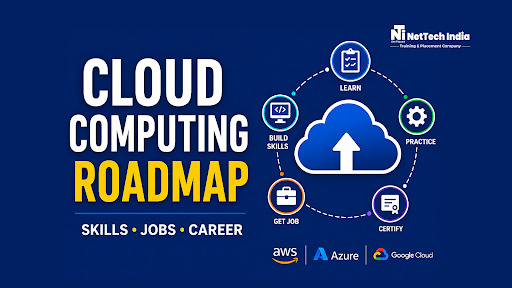
Cloud computing has become one of the fastest-growing career fields in the IT industry. Today, companies of all sizes use cloud platforms to store data, manage applications, improve security, and scale their operations. Because of this shift, the demand for skilled cloud professionals surged across India.
If you are a student or a fresher exploring career paths, cloud computing is one of the most promising fields because it offers strong career growth, good salaries, and long-term opportunities in India and abroad.
Check out the step-by-step guide below to get a clear cloud computing roadmap in 2026:
Cloud Computing Roadmap (2026)
Step 1: Build Basic IT Knowledge
The first step in the cloud computing roadmap is understanding basic IT concepts. Before learning advanced cloud tools, you should become familiar with networking, operating systems, databases, and Linux basics.
For example, when you understand how websites work, how servers communicate, and how data transfers over networks, you will find cloud concepts much easier to grasp later. You can enrol in the best IT training institute to strengthen your fundamentals and get practical training.
You don’t need to become an expert immediately, but a strong foundation makes learning much easier.
Step 2: Understand Cloud Computing Fundamentals
Once your basics are clear, the next step is learning how cloud computing actually works.
You should understand concepts like public cloud, private cloud, virtualization, cloud storage, and scaling in cloud computing. Scaling is especially important because businesses need systems that can handle increasing users and traffic without performance issues.
At this stage, you should also understand the difference between services like IaaS, PaaS, and SaaS. These concepts are commonly asked during interviews and are important for beginners entering cloud computing jobs in India.
Step 3: Learn a Cloud Platform
After learning the fundamentals, you should start learning a cloud platform such as AWS, Microsoft Azure, or Google Cloud Platform. You can learn from the best cloud computing training courses, which cover basics to advanced concepts.
AWS is usually the most recommended option for beginners because it dominates the market and creates strong cloud computing job opportunities for freshers. Most companies today look for candidates who have hands-on exposure of cloud services like virtual machines, cloud storage, networking, and deployment.
Instead of only watching tutorials, you must practice using cloud dashboards and services regularly. Practical exposure is extremely important in this field.
Cloud environments depend a lot on Linux systems. That is why learning Linux commands, server management, and basic scripting is an important part of the cloud computing roadmap.
Step 4: Learn Linux and Basic Scripting
You should also learn simple scripting concepts using Python or Bash because automation is a major part of cloud operations today. Even basic scripting knowledge can improve problem-solving ability and help you during interviews for entry level cloud computing jobs.
At this stage, you start becoming comfortable working with real cloud environments instead of only understanding theory.
Step 5: Work on Practical Projects
One of the biggest mistakes students make is focusing only on theory without building projects.
Companies hiring for cloud computing jobs for freshers usually prefer candidates who can demonstrate practical skills. You should focus on building small projects like AWS website hosting, cloud storage configuration, applications, or creating backup systems.
Practical learning helps you understand real-world implementation and improves confidence during technical interviews. It also strengthens resumes and LinkedIn profiles significantly.
Opt for a cloud computing course with placement support to prepare yourself for real industry jobs with mock interviews and personality development sessions.
Step 6: Earn Certifications and Internship Experience
Certifications help you validate your knowledge and improve career opportunities. Also, you can aim for popular certifications like AWS Certified Cloud Practitioner and Microsoft Azure Fundamentals.
Along with certifications, you should also try applying for a cloud computing internship. Internship programmes provide real industry exposure and help you understand how cloud systems are actually managed inside organisations.
Cloud Computing Jobs and Salary in India
The demand for cloud professionals has increased rapidly over the last few years. If you have strong foundational skills with practical learning and certification, the ideal cloud computing jobs for freshers you can apply for are Cloud Support Associate, Cloud Engineer, DevOps Engineer, and Cloud Administrator.
Today, there are multiple cloud computing remote jobs available as well, especially in support and operations roles. This gives you flexibility and wider career opportunities.
The cloud computing salary in India depends on skills, certifications, industry, and experience level. The average cloud computing fresher salary usually starts between ₹3 LPA and ₹5 LPA. With certifications and practical experience, you can quickly move into higher-paying roles.
How to Choose the Right Cloud Computing Course
Many students search online for “best cloud computing near me” because selecting the cloud computing best institute is an important step.
A good training programme should focus more on practical learning instead of just teaching theory. You must choose the cloud computing training course that includes hands-on learning, live projects, recognised certification, resume support, and complete placement assistance.
Before enrolling, you should check trainers’ expertise, curriculum quality, placement records, and cloud computing courses fees. If you choose a course only because it is cheaper, it may not provide the practical exposure and quality training that is required for real industry jobs.
Final Thoughts
Cloud computing has become one of the most future-focused career paths in the IT industry. As companies continue moving toward cloud-based infrastructure, the demand for skilled professionals is expected to grow even further.
The good thing is that as a beginner, you don’t need to learn everything at once. By following the right cloud computing roadmap, building practical skills, working on projects, and gaining certifications, you can gradually become job-ready.
If you are a beginner looking to build a career in cloud computing, this field offers excellent long-term opportunities and career growth.
Common Cloud Computing Questions & Answers
What exactly is Cloud Computing?
Cloud computing is using internet-based services like storage, software, and servers instead of owning and managing physical computers or hardware. It helps anyone access files, applications, and data online anytime, from anywhere, without expensive systems or technical setup
What are the 4 types of Cloud Computing?
The four main types are Public Cloud, Private Cloud, Hybrid Cloud, and Multi-Cloud. Each type of cloud computing offers different levels of flexibility, security, and control.
Is Cloud Computing an IT job?
Yes, cloud computing is a booming field in the IT industry. It includes roles like Cloud Engineer, DevOps Engineer, and Cloud Administrator.
What are the top 3 cloud technologies?
The top three cloud technologies are Amazon Web Services (AWS), Microsoft Azure, and Google Cloud Platform (GCP). These platforms are commnly used by companies across industries.
What is Cloud Salary?
Cloud computing freshers in India can typically earn between ₹3 LPA and ₹5 LPA, depending on knowledge and skills. Experienced cloud professionals can earn over ₹10 LPA based on their experience.